Tempo Notation Explained: 4-Digit System, History, and Common Mistakes
How to read 3-1-1-0, what X means, and the conventions that confuse lifters who try to apply tempo prescriptions for the first time.
Why notation matters
Tempo notation looks like a code. To someone who hasn't seen it before, "Bench Press 5×5, tempo 3-1-1-0" is gibberish. To someone who reads it daily, it's the most efficient way to communicate exactly how a rep should be performed.
The notation isn't decorative. It encodes information that words can't easily compress: the duration of each phase of a rep in seconds, the order in which those phases happen, and the conventions that handle edge cases like explosive intent or isometric holds. A 4-digit number does in 7 characters what would take three sentences to describe in plain English.
This is why every serious strength program uses some form of tempo notation. Charles Poliquin's 4-digit system is the most common standard, though it's not the only one. Ian King had a 3-digit system that predated Poliquin. Older programs used "slow", "medium", "fast" as descriptors. Modern bodybuilding sometimes shorthand to "30X1" without explicit dashes. Each system trades clarity for compactness in different ways.
This guide explains how to read the standard 4-digit notation, where it came from, what the conventions actually mean, and the most common mistakes I see lifters make when they first try to apply tempo prescriptions to their training.
Reading the 4-digit system
Phase order is fixed
The four digits always represent four phases of a rep, in this order:
- 1st digit - Eccentric: the lowering or stretching phase. Duration in seconds.
- 2nd digit - Pause at the bottom: the stretched/loaded position. Duration in seconds.
- 3rd digit - Concentric: the lifting or shortening phase. Duration in seconds.
- 4th digit - Pause at the top: the contracted/locked-out position. Duration in seconds.
So 3-1-1-0 reads as: 3 seconds eccentric, 1 second pause at bottom, 1 second concentric, 0 pause at top. Total rep duration: 5 seconds.
The order is fixed across all variations of the notation. This matters because some lifters intuit the order as "down, up, pause, pause" - which is wrong. Correct order is "down, pause, up, pause". The pause at the bottom is the second digit because it's the second event in the rep.
| Tempo | Reads as |
|---|---|
3-0-1-0 | 3s down, no pause, 1s up, no pause |
3-1-1-0 | 3s down, 1s pause bottom, 1s up, no pause |
4-0-X-0 | 4s down, no pause, explosive up, no pause |
X-0-1-30 | Get into position fast, no pause, 1s set, 30s hold |
Notation is eccentric–pause–concentric–pause, in seconds. 3-0-1-0 is 3 seconds lowering, 1 second lifting, and no pause where the notation reads zero. X is a directive rather than a duration: move as fast as you can.
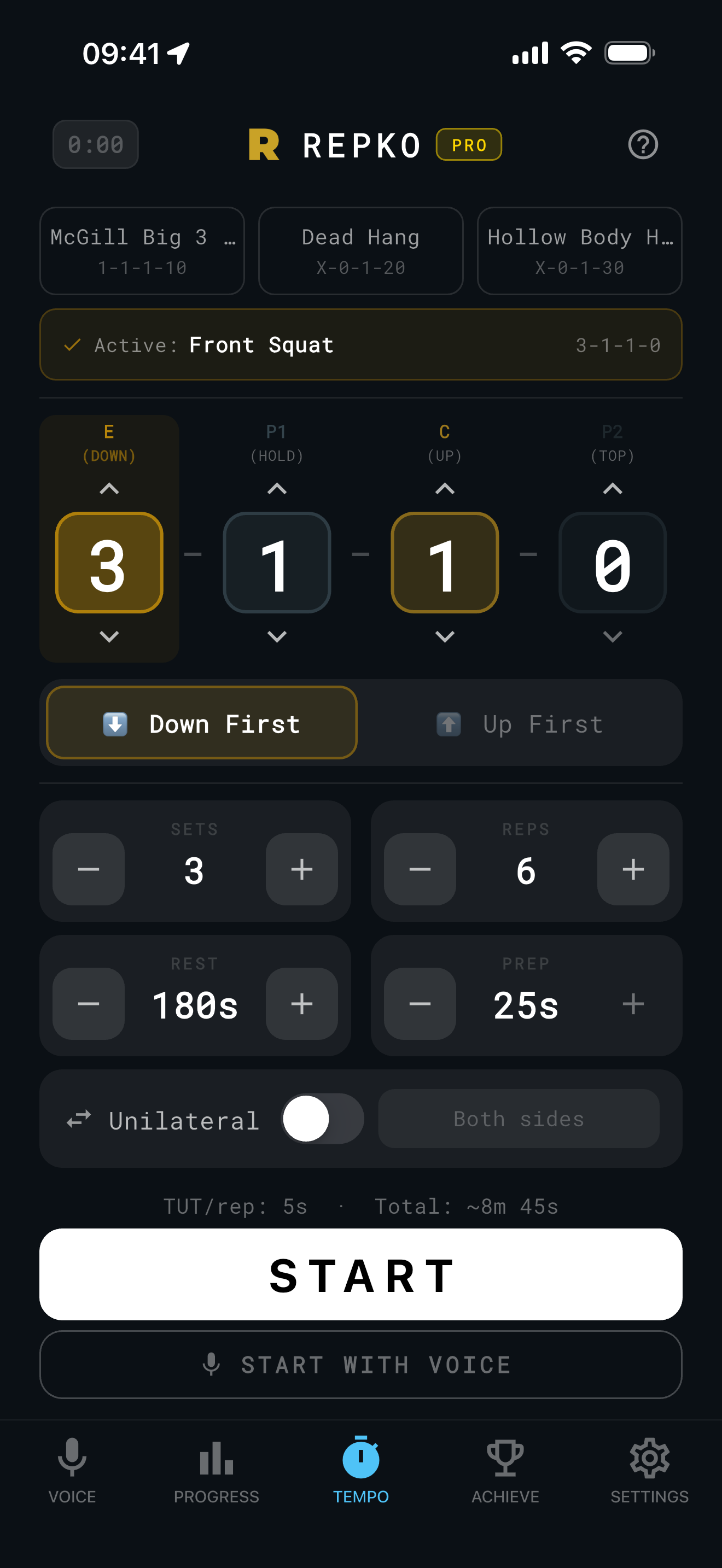
The X convention - explosive intent
Any digit can be replaced with the letter X. The X means "as fast as possible" or "with maximum intent". It's not a duration - it's a directive about how to apply force.
Most often X appears in the 3rd position (concentric) for power-focused work. 3-1-X-0 means: 3 seconds down, 1 second pause, lift with maximum intent, no pause at top. The lifter applies as much force as possible during the concentric phase. Whether the bar moves quickly or slowly is determined by the load - under heavy weight, the bar moves slowly even with X intent.
X also appears in the 1st position (eccentric) for isometric work. X-0-1-30 means: get into position quickly, no pause, 1 second to set, then 30-second hold. This convention is common in calisthenics for hollow body holds, planks, and dead hangs.
The key principle: X is about intent, not about result. A heavy bench press at 3-0-X-0 might still take 2 seconds to lock out concentrically. The X tells you to push as hard as you can, regardless of how fast the bar actually moves.
When the 4th digit becomes a hold time
For isometric exercises, the 4th digit can represent seconds of hold time rather than a pause between reps. This is a calisthenics and core-training convention.
1-1-1-10 for a Side Plank means: 1 second to enter the position, 1 second pause at bottom of entry, 1 second concentric setup, then a 10-second hold. The 10 isn't a pause before the next rep - it's the work itself.
Similarly, X-0-1-30 for a Hollow Body Hold means: get into position fast, no pause, 1 second to set, then 30-second hold. The 30 is the duration of the static contraction.
This convention can confuse beginners reading their first calisthenics program. If you see a tempo where the 4th digit is unusually large (10, 20, 30+), assume it's a hold time. If the 4th digit is small (0, 1, 2), it's a pause between reps.
Where the notation came from
Tempo prescriptions in their modern form came from two strength coaches working in parallel during the 1990s. Australian coach Ian King developed a 3-digit system that captured eccentric, pause at bottom, and concentric. Canadian coach Charles Poliquin extended it to 4 digits by adding the pause at the top.
The 3-digit version still exists in some old training programs. 301 means 3-second eccentric, no pause, 1-second concentric - the same as 3-0-1-0 in 4-digit notation. The two systems are interchangeable for most prescriptions; the 4th digit just makes the pause at the top explicit instead of leaving it ambiguous.
You'll occasionally see compressed notation without dashes - 3010 instead of 3-0-1-0. This is purely formatting; the meaning is identical. Modern programs use dashes for readability, especially when the notation includes X (e.g., 3-0-X-0 reads more clearly than 30X0).
Other tempo conventions exist outside the Poliquin lineage. Mike Mentzer's Heavy Duty methodology used 3-digit notation in the form of 4-2-4 (4-second concentric, 2-second pause at peak, 4-second eccentric), with TUT targets of 60-90 seconds per set. The Super Slow protocol developed by Ken Hutchins prescribed 10-second concentric and 10-second eccentric durations, framed as "10-10" notation rather than 4-digit per-phase. Older bodybuilding programs (pre-1990s) just said "slow", "medium", or "fast" without specific seconds.
The 4-digit system won mainstream adoption because it's the most precise standard available. It encodes more information than the 3-digit version, more compactly than full TUT prescriptions, and more consistently than verbal descriptors. Poliquin's notation is the lingua franca of serious strength programming, even when individual coaches modify it for specific applications.
Common mistakes when applying tempo prescriptions
Mistake 1: Treating the eccentric as the only phase that matters
The most frequent error. Lifters slow down the descent on a 3-1-1-0 squat - they actually take 3 seconds - but bounce out of the bottom and rush the concentric. The 1-second pause at the bottom is skipped. The concentric is faster than 1 second.
This converts a prescribed 3-1-1-0 (5-second rep) into something closer to 3-0-0.5-0 (3.5-second rep). 30% reduction in TUT, 30% reduction in stimulus. The lifter feels they're doing tempo work because the eccentric is correct. The lifter's training is unchanged.
Mistake 2: Choosing tempos that are too aggressive too soon
A lifter switches from their normal "drop and stand" cadence to a 5-0-1-0 squat at the same load. Within two reps they fail. They blame the tempo, drop the prescription, return to normal cadence.
The fix: the load needs to drop with the tempo. A 5-second eccentric typically requires 30-40% load reduction compared to your normal cadence. Start with 70% of your previous working weight. If you finish 8 reps comfortably, increase. The slow tempo is the stimulus - the load is calibrated to the tempo, not the other way around.
Mistake 3: Counting in your head while lifting heavy
The mental arithmetic of counting "one, two, three" through a heavy set while also tracking rep number, breathing, and form is too much. Concentration breaks. The count becomes unreliable past rep 4.
Solutions exist: a metronome, verbal counting from a training partner, or a tempo timer with audio cues like the one I built into Repko. The point isn't gadgetry - it's offloading the cognitive task so your attention can stay on the lift.
Mistake 4: Applying tempo to every lift, every set, every session
Tempo work is a stimulus. Like any stimulus, it stops working when overused. Programs that prescribe slow tempo on every exercise of every workout for months on end produce diminishing returns and joint fatigue.
The fix: use tempo prescriptions in dedicated blocks. 4-6 weeks of slow eccentrics, then 2-3 weeks of faster cadences for power work, then return when you need the stimulus again. Cycling tempo is more productive than constant slow work.
Mistake 5: Ignoring the X when it appears
X is intent, not speed. Lifters seeing 3-0-X-0 sometimes interpret X as "fast eccentric and slow concentric, somehow". The reality: X means apply maximum force during the concentric. Whether the bar moves fast (light load) or slow (heavy load) is determined by physics, not by you.
How Repko handles edge cases: notation, direction, and contraction type
Standard 4-digit notation describes a rep as four phases: eccentric, pause at the bottom, concentric, pause at the top. The notation digits are always written in this order - that's the convention. But the assumption baked into most timer apps is that the eccentric phase always comes first physically, and that "first" always means lowering down. Both assumptions are wrong for a meaningful number of lifts.
The notation order is fixed. The execution order isn't.
Take a Front Squat at 3-1-1-0 and a conventional Deadlift at 3-1-1-0. Same notation. Same digits in the same order: eccentric 3, pause1 1, concentric 1, pause2 0. But the rep starts differently. The squat starts with the eccentric phase - you sit down before you stand up. The deadlift starts with the concentric phase - you lift the bar before you lower it. The notation digits stay constant because they're labels for phase types, not phase ordering.
Repko handles this by separating two concepts: the four phase types (E-P1-C-P2, always in that label order) and the order in which those phases happen during a rep. Each exercise has a configurable direction. Down First means the rep starts with whatever phase type happens during downward motion. Up First means it starts with the upward motion. The default depends on the exercise - squats and presses default to Down First, deadlifts and dead-hang pull-ups default to Up First.
Eccentric isn't always "going down"
Here's where most apps get it wrong. The convention "eccentric = lowering" works for the majority of lifts because gravity does most of the work in compound barbell movements. But eccentric is a physiological term, not a directional one. Eccentric means the muscle is lengthening under load. Concentric means it's shortening under load. The direction the load travels in space is a separate question.
The clearest example is a Lat Pulldown. The bar travels downward toward your chest. By the "down = eccentric" assumption, the first phase should be eccentric - slow controlled lowering. But that's physiologically backwards. When you pull the bar down, your lats are shortening to do the work. That's a concentric contraction, even though the load is moving down. The slow controlled phase is when the bar travels back up to the start, which is when your lats are lengthening. That's the eccentric.
The same applies to Cable Tricep Pushdowns, Cable Crossovers (high-to-low), Woodchops, Cable Crunches, Seated Leg Curls, and most cable or machine exercises where the working muscle pulls the load downward against the cable's resistance. There are 29 such exercises in Repko's database where downward motion is concentric and upward motion is eccentric.
The eccentric-first toggle
Each exercise in Repko has a second flag in addition to direction: whether the first phase of the rep is eccentric or concentric. For most lifts, this flag is "yes" - the rep starts with the eccentric phase, which is the default for a 3-1-1-0 prescription. For Lat Pulldown and similar movements where downward motion is the working phase, the flag is "no" - the rep starts with concentric, and the digits are read accordingly.
The result: a Lat Pulldown at 3-1-1-0 means 3 seconds for the working phase (the pull down), 1 second pause at the bottom of the pull, 1 second on the controlled return upward (eccentric), 0 pause at the top. The notation digits are the same as a Front Squat at 3-1-1-0. The execution is biomechanically opposite. The lifter doesn't have to translate notation in their head; the app already knows.
Long-press to swap
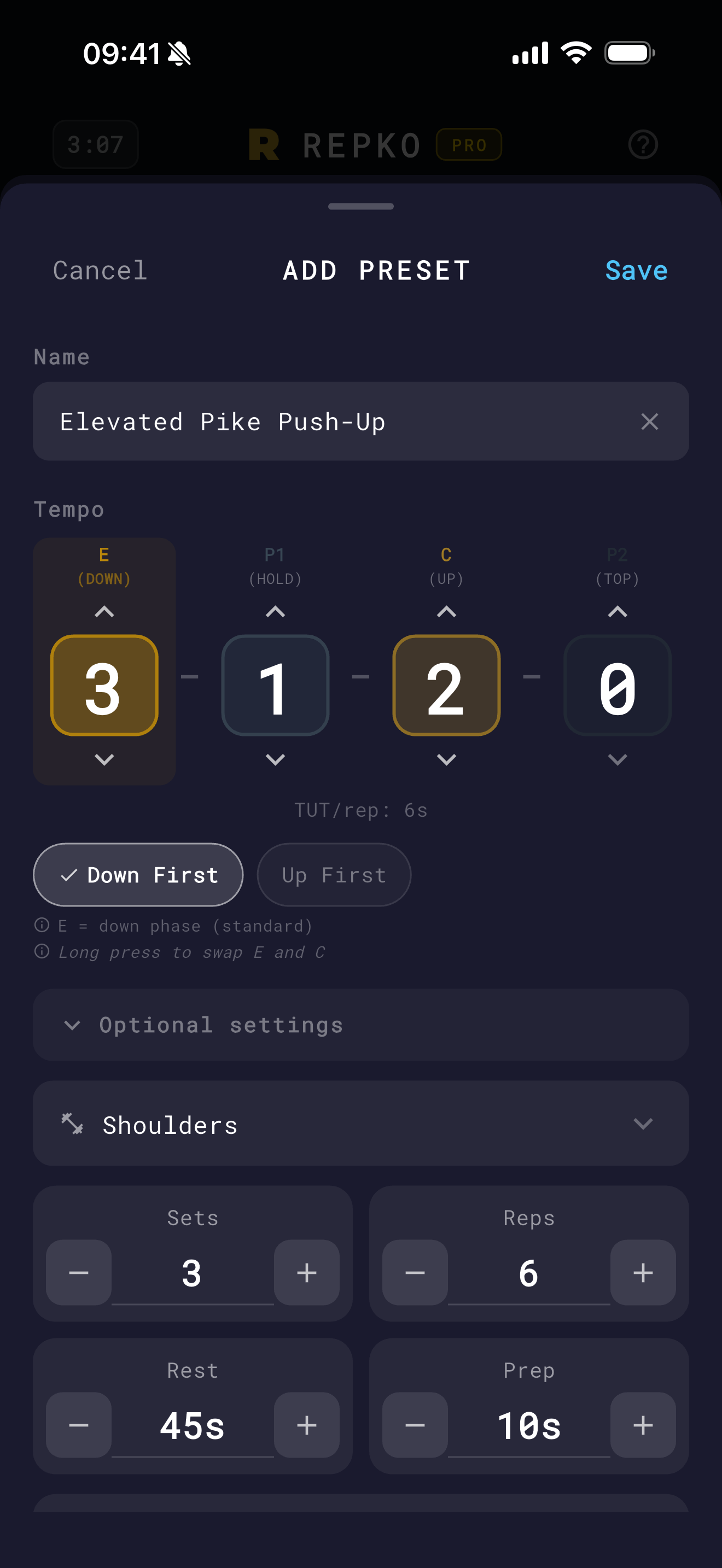
Both flags are configurable per exercise - both on the main timer screen and in the preset edit/add view. Long-press the Down First / Up First button and the eccentric phase swaps to the concentric position, and vice versa, in either direction. This handles edge cases the database can't predict: a personal cue you've developed, a non-standard variation of a movement, a unilateral progression where the direction differs from the bilateral default.
This is a small detail of timer design that matters more than it should. The notation stays a stable language across all exercises. The execution adapts to physical reality. Lifters don't lose seconds trying to mentally remap "the eccentric is actually going up" during a heavy set.
Frequently asked questions
What does the X in tempo notation mean?
X means "as fast as possible" or "with maximum intent". It replaces a numeric duration. Most often it appears in the 3rd position (concentric) for power-focused work, or in the 1st position (eccentric) for isometric holds where you want to get into position quickly. X is about applied force, not about how fast the bar actually moves - under heavy load, a rep with X concentric might still take 2 seconds.
Is there a difference between 3-0-1-0 and 3010?
No, they mean exactly the same thing. The dashes are formatting for readability, especially helpful when the notation includes X (e.g., 3-0-X-0 reads more clearly than 30X0). Modern programs use dashes. Older programs sometimes use the compressed form without separators.
What if I see a 3-digit tempo like 301?
Three-digit notation is the older Ian King system. 301 means 3-second eccentric, no pause, 1-second concentric - equivalent to 3-0-1-0 in modern 4-digit notation. The 3-digit form just leaves the pause at the top implicit (typically zero). The two systems are interchangeable for most prescriptions.
Why is the 4th digit sometimes 30 or larger?
For isometric exercises (planks, holds, hangs), the 4th digit often represents seconds of hold time rather than a pause between reps. So X-0-1-30 for a Hollow Body Hold means a 30-second isometric hold, not a 30-second rest between reps. This is a calisthenics and core-training convention. If the 4th digit is unusually large, assume it's a hold time.
Should beginners worry about tempo notation?
Not initially. A beginner benefits most from controlled execution on compound lifts - say, a 3-second descent on every squat - without tracking specific 4-digit prescriptions. Once that habit is established, tempo notation becomes useful for communicating more specific prescriptions in writing. Start with the habit, add the notation when you need to communicate beyond yourself.
How does Repko handle tempo notation?
Repko uses the standard 4-digit Poliquin notation throughout. Every exercise can be configured with a 4-digit tempo, the X convention is supported in any position, and the audio cues count down each phase second by second. Repko was built by a lifter who needed exactly this notation for daily training. Read the broader tempo training guide for context on how the notation translates to actual training prescriptions.
Notation is a tool, not the work
Tempo notation is a way to communicate. It's not the training itself. The numbers tell you what to do; doing it consistently is what produces adaptation.
If you're new to tempo work, pick one prescription that fits your goal - 3-1-1-0 for tendon health, 4-0-X-0 for power, X-0-1-30 for isometric core - and run it for 8-12 weeks. Don't try to apply tempo to everything. Don't switch prescriptions every session. Pick one, run it, evaluate.
If you're already comfortable with the notation, the value of writing it explicitly comes when you communicate with training partners, write programs for yourself or others, or want a precise record of what you did versus what you intended.
Repko is live on the App Store. Read more about the app or follow development on Featurebase.