Eccentric Training: Science, Applications, and Real-World Tempo Prescriptions
Why slow lowering builds different qualities than fast lifting - and what the research actually shows about heavy slow resistance.
Why eccentrics matter
Eccentric training is the most-researched, least-applied training variable in serious lifting. Most lifters focus on what they push up. Eccentric training focuses on what comes down.
I came to eccentric training out of necessity, not curiosity. I had jumper's knee that wouldn't quit and a lower back that complained every time I jumped back into heavy work after a deload. Slowing down the eccentric on Front Squats - moving from random "down-up" cadence to a deliberate 3-1-1-0 - did more for my knee than anything else I'd tried. The same principle applied differently - McGill Big 3 with strict 10-second holds - did the same for my back.
That experience matched what the research has been showing for decades. Eccentric loading drives different adaptations than concentric work. It changes tendon mechanical properties. It builds tissue qualities that concentric work alone doesn't reach. And it does so while letting you train through pain that would otherwise stop you from training at all.
This guide explains what the research actually shows about eccentric training, the protocols with the strongest evidence base (Kongsgaard's HSR, Alfredson's protocol, Beyer's comparison study), and how I apply slow eccentrics across barbell work, calisthenics, and isometric core training.
What the research actually shows
The Alfredson protocol - where it started
The most-cited eccentric training research started in 1998 with Hakan Alfredson and colleagues. Their study, published in The American Journal of Sports Medicine (PubMed: 9617396), focused on chronic Achilles tendinopathy. The protocol was elegant in its simplicity - three sets of 15 eccentric heel drops, twice a day, seven days a week, for 12 weeks. The eccentric portion was loaded; subjects used a partner or healthy leg to return to the start position concentrically.
The results changed clinical practice. All 15 patients with chronic, recalcitrant tendinopathy returned to full running, pain during activity fell significantly, and calf strength on the injured side caught up with the uninjured side. A comparison group treated conventionally all ended up in surgery. The Alfredson protocol became the conservative-treatment baseline against which everything since has been measured. Note what it did not measure: strength and pain were the outcomes, not tendon structure.
What the research did NOT show was that eccentric-only loading was uniquely magic. Subsequent studies have asked: is it the eccentric phase, or is it the slow controlled tempo applied to both phases?
Heavy slow resistance, the protocol people finish
The answer, so far, is that the eccentric phase does not appear to be uniquely magic. In 2009, Kongsgaard and colleagues published a randomized trial (Scandinavian Journal of Medicine & Science in Sports, PubMed: 19793213) comparing three treatments for jumper's knee - corticosteroid injections, eccentric decline squat training, and heavy slow resistance (HSR).
HSR used both eccentric and concentric phases at controlled 3-second tempo, three times per week, with progressively heavier loads. The eccentric-only group did the classic decline squat protocol.
The results: at 12 weeks, all three groups showed similar pain and function improvement. But at six-month follow-up, the HSR group maintained gains while the corticosteroid group regressed. More importantly, HSR produced measurable structural change that the eccentric-only group did not: elevated collagen network turnover, and reductions in tendon swelling (12%) and vascularization (45%). 70% of HSR participants reported satisfaction at six months versus 22% in the eccentric-only group.
Beyer's 2015 randomized trial in The American Journal of Sports Medicine (PubMed: 26018970) asked the same question in Achilles tendinopathy, and its answer was a draw. Both groups improved significantly and held those gains at 52 weeks, tendon thickness and neovascularization fell in both, and none of the clinical or structural improvements differed between eccentric training and HSR. What did differ was adherence: 92% of prescribed sessions completed on HSR against 78% on the eccentric protocol. So the honest reading is not that HSR builds better tendons. It is that HSR is the protocol people actually finish, and a protocol you finish beats an equivalent one you abandon.
What this means in practice
The research has converged on a few practical principles. First, the eccentric phase matters - but as part of a controlled tempo, not as an isolated emphasis. Second, the load needs to be heavy. HSR studies use 70-85% of 1RM with the slow tempo applied. Third, the work needs to be sustained. 12 weeks is the typical research duration; tendon adaptations are slower than muscle adaptations.
For a working lifter, this translates simply: heavy loads with deliberate 3-second eccentric and 3-second concentric work, 2-3 times per week, run for at least 8-12 weeks before evaluating results. That's approximately a Front Squat at 3-1-3-0 tempo with weights you can actually handle for 6-8 reps.
This is also why I write about tempo training broadly rather than eccentric isolation. The framework that works for tendon health is the same framework that works for hypertrophy and strength: controlled tempo across both phases, with deliberate intent on each.
Three applications I use weekly
Front Squat 3-1-1-0 - loaded HSR
Front Squat at 3-1-1-0 is my main loaded lower-body exercise. Working in the 50-60 kg range for 6-8 reps, three times per week. The 3-second eccentric and 1-second pause at the bottom let me apply HSR principles in a movement my knees actually tolerate.
Why Front Squat instead of Back Squat? When jumper's knee was active, Back Squat with my normal "drop and stand" tempo aggravated it within two weeks. Front Squat with a deliberate slow eccentric did the opposite - it built the tendon qualities I needed. The bar position (front rack) plus the slower tempo plus the lighter load all combined into something my knee tolerated.
Important context: this is not a rehab protocol prescription. It's what worked for me, applied as a training tool within my own training. If you have active tendinopathy, work with someone who can assess your specific situation. The research shows that controlled tempo work helps - it does not show that any specific person should follow any specific tempo without proper context.
What I track in Repko: weight, RIR, tempo execution. The 3-1-1-0 tempo means a 5-second rep. At 8 reps, that's 40 seconds of TUT - solidly in the productive hypertrophy range while loading the tendon at the heavy slow tempo the research supports. For a deep dive on front squat tempo prescriptions specifically - biomechanics, velocity-based interpretation, pause vs rebound - see front squat tempo prescriptions. For the deadlift family, where eccentric strategy diverges sharply between conventional (heavy, reset, no slow eccentric) and Romanian (slow eccentric is the whole point), see deadlift & RDL tempo prescriptions.
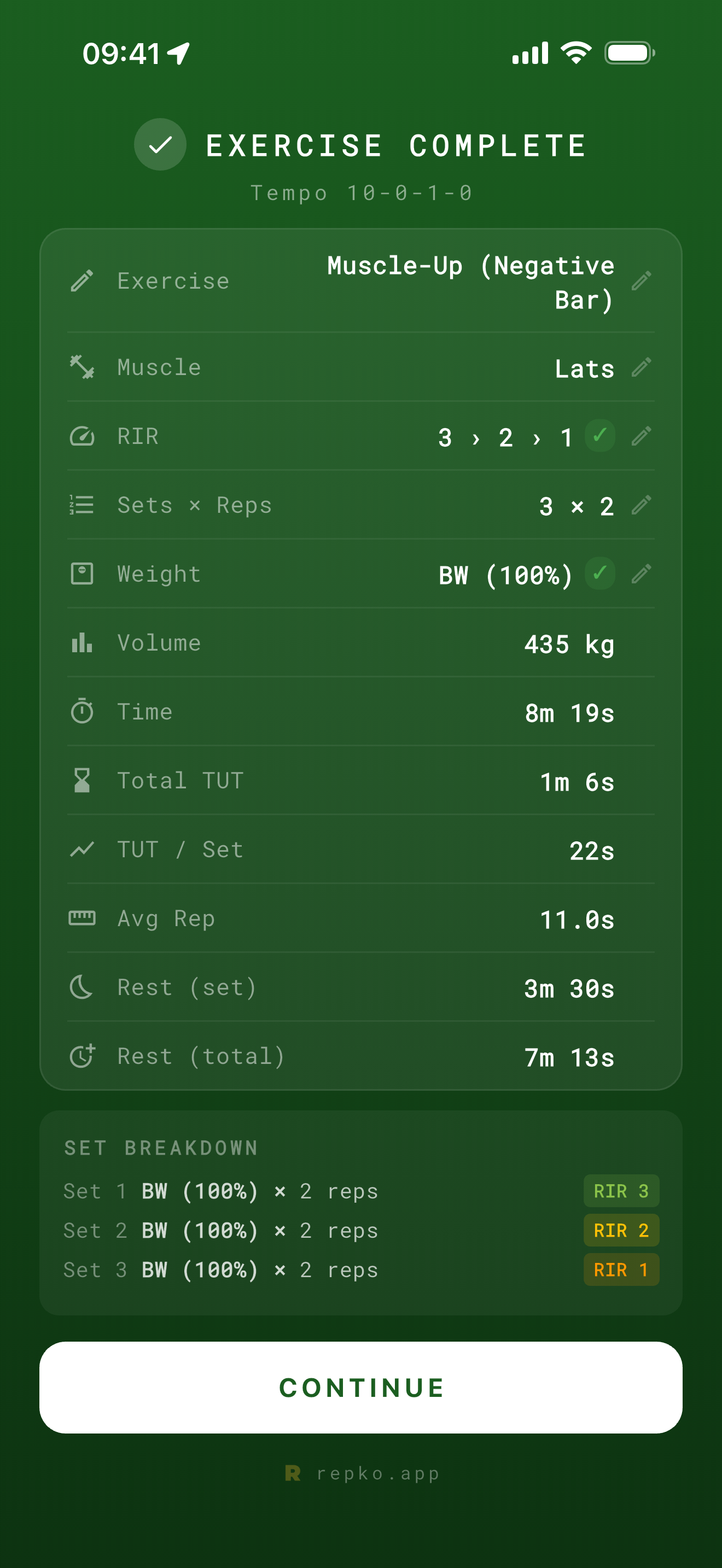
Muscle-Up Negative 10-0-1-0 - natural eccentric overload
Calisthenics is where eccentric overload becomes natural. You can't add 2.5 kg to a muscle-up the way you can to a bench press. But you can do a 10-second eccentric descent from the top position, then use a band, box, or partner to get back to the start.
This is eccentric overload in the classical sense - you're handling more during the lowering phase than you can press up. The 10-second tempo turns a muscle-up negative from "controlled drop" to a different exercise entirely. You feel weaknesses at every position of the descent. The first time you try a 10-second negative, you discover exactly which segment of the rep your strength fails.
I work this drill weekly, 3 sets of 1-2 negatives, with the 10-0-1-0 tempo enforced strictly. The Repko voice cue counts down each second - without it, I lose count past 6 seconds when fatigue builds. For the full muscle-up family deep-dive, bar versus ring, phase-gated progression model, and the most aggressive skeptical audit in the cluster, see bar muscle-up and negative tempo prescriptions.
The same principle applies to weighted Pull-Up negatives, Dip negatives, and any other compound bodyweight pattern. Slow eccentrics build position-specific isometric strength that you cannot get from regular tempo reps. The research on this in calisthenics is thinner than the tendinopathy literature, but the broader hypertrophy and tendon-loading principles transfer directly. For the lat pulldown and pull-up family specifically, where the seated pulldown eliminates grip-endurance limiters and the eccentric-only pull-up rests on Nuzzo et al.'s 2023 meta-analytic 1.41 eccentric-to-concentric strength ratio, see lat pulldown and pull-up tempo prescriptions.
Side Plank 1-1-1-10 - isometric-eccentric hybrid
The third application is the McGill Big 3 protocol for spine health. Stuart McGill's research (published across multiple peer-reviewed papers on spine biomechanics) recommends side plank with deliberate hold timing rather than as an open-ended endurance test.
The 1-1-1-10 tempo means: 1-second rise into position, 1-second pause at bottom of the entry, 1-second concentric, 10-second hold at top. The 10-second hold is the work. Multiple short-duration holds with full rest between sets, rather than one long hold to failure.
This is technically isometric work, not eccentric, but it shares the principle that matters: deliberate timing produces different adaptations than open-ended execution. McGill's research shows that short, paced holds build endurance qualities that protect the spine from buckling under load, without producing the fatigue accumulation that long planks create.
I run McGill Big 3 daily - Side Plank, Bird Dog, Curl-Up - usually as warmup before squats or pulls. It takes seven minutes. It's the most consistent rehabilitation tool in my training.
For the full McGill Big 3 deep-dive, anti-motion plane framework, the 10-second hold ceiling from McGill, Hughson and Parks's paraspinal oxygenation research, the Russian 5-3-1 descending pyramid, the normative endurance database for asymmetry diagnostics, and the Repko notation extension for static-isometric holds, see side plank and McGill Big 3 tempo prescriptions.
Frequently asked questions
Is eccentric training only for rehabilitation?
No. Eccentric training is a productive stimulus for hypertrophy and strength regardless of injury status. The most-cited research happens to be in rehabilitation contexts because that's where eccentric loading is most dramatically effective. But the same controlled-tempo principles apply to general strength and hypertrophy training.
What's the difference between eccentric training and HSR?
Eccentric training emphasizes the lowering phase, often with assistance for the concentric. Heavy Slow Resistance (HSR) applies controlled slow tempo to both eccentric and concentric phases, typically using normal bilateral movements with progressively heavier loads. Research suggests HSR produces equal or superior tendon outcomes to eccentric-only protocols, with better long-term adherence.
How heavy should the load be for HSR work?
The research uses 70-85% of 1RM with controlled 3-second eccentric and 3-second concentric tempo. Sets of 6-15 reps depending on rep range goal. Three sessions per week is the typical research dosage. Practical translation: the load needs to feel heavy at the slow tempo, not just heavy at fast tempo.
Can I do eccentric overload at home without equipment?
Yes - calisthenics negatives are natural eccentric overload patterns. Muscle-Up Negative, Pull-Up Negative, Dip Negative, Pistol Squat Negative. You handle more body weight in the eccentric than you can press concentrically, and use a band or jump-up to get back to the start. The tempo controls how much "overload" the eccentric becomes.
How does Repko handle eccentric training?
Repko's 4-phase tempo notation directly supports any eccentric-emphasized protocol. A 5-0-1-0 tempo for eccentric overload, a 3-1-3-0 tempo for HSR, a 10-0-1-0 for calisthenics negatives - each prescription is configurable and the voice cues count out the eccentric phase second by second. Repko was built by a lifter who needed exactly this for daily training.
Should beginners do eccentric work?
Yes, but simply. When I started using tempo work, I didn't run 5-0-1-3 protocols - I just slowed down the eccentric on compound lifts to a controlled 3-second descent. That alone is most of the benefit. Eccentric overload protocols (5-0-1-0 with assistance, calisthenics negatives) are advanced applications that build on the basic tempo habit, not entry points.
The principle, not the protocol
Eccentric training works because deliberate execution works. The same principle that makes Alfredson's protocol effective for Achilles tendinopathy makes Front Squat 3-1-3-0 effective for general strength training. Controlled lowering forces the body to do work it skips when you let gravity drop the load.
The protocols matter less than the principle. Pick a movement you can load, slow down the eccentric to 3 seconds minimum, run that for 8-12 weeks, evaluate. Whether you call it "HSR", "eccentric training", or "tempo work" matters less than whether you actually do it consistently.
If you want a tool that handles the cognitive load of pacing - voice cues, automatic TUT calculation, tempo notation that supports any 4-digit prescription - read about why I built Repko. Or check the broader Poliquin tempo training guide for context on how tempo prescriptions are constructed.
Repko is live on the App Store. Follow development on Featurebase.