Poliquin Tempo Training: A Complete Guide
Why a 4-second eccentric isn't the same as a 2-second one - and how to use that difference deliberately.
Why this guide exists
If you've ever read "Bench Press 5×5, tempo 3-1-1-0" and wondered what those four numbers actually mean - this guide is for you. If you've already used tempo prescriptions but want to understand the science behind why they work - also for you.
I started using tempo training out of necessity. Years into lifting, I had jumper's knee that wouldn't quit and a lower back that complained any time I jumped back into heavy work after a deload. Slowing down the eccentric on Front Squats - moving from random "down-up" cadence to a deliberate 3-1-1-0 - did more for my knee than anything else I'd tried. Adding McGill Big 3 with strict 10-second holds did the same for my back. Tempo wasn't just a hypertrophy tool. It was the difference between training and not training.
That experience taught me what most strength athletes eventually discover: tempo isn't just speed. It's a way to control which adaptations your training produces. Slow eccentrics build different tissue qualities than fast ones. A 1-second pause at the bottom of a squat changes the lift's neurological demand. The numbers in a tempo prescription encode all of that.
This guide explains the system, the research, and how to actually apply it. No fluff, no fitness influencer voice. Just what works and why - from someone who uses it daily.
How tempo notation works
The four numbers
Tempo prescriptions use a 4-digit notation. Each number represents the duration of one phase of a rep, in seconds. The order is fixed:
- 1st digit - Eccentric (the lowering or stretching phase). For a squat, this is the way down. For a pull-up, this is the way down from the top.
- 2nd digit - Pause at the bottom (the stretched position). For a squat, this is the moment at the bottom. For a bench press, this is the bar touching the chest.
- 3rd digit - Concentric (the lifting or shortening phase). For a squat, this is the way up. For a pull-up, this is pulling toward the bar.
- 4th digit - Pause at the top (the contracted position). For a squat, this is locked out at the top. For a pull-up, this is chin over bar.
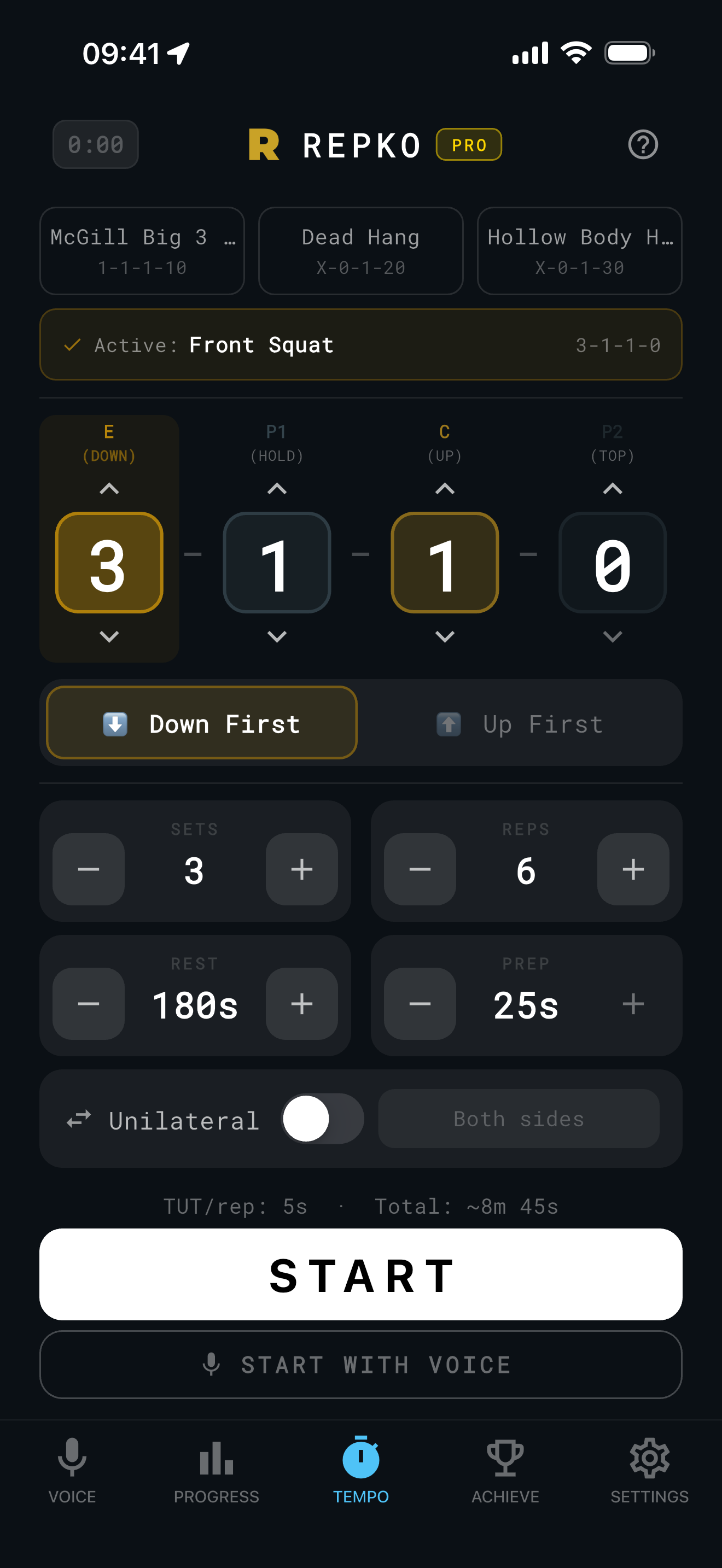
So 3-1-1-0 means: 3 seconds down, 1-second pause at bottom, 1 second up, no pause at top. Total time per rep: 5 seconds.
Reading common tempos
Once you understand the structure, common tempos start to make sense:
| Tempo | Meaning | Common use |
|---|---|---|
2-0-1-0 | 2s down, no pause, 1s up, no pause | Standard hypertrophy work |
3-1-1-0 | 3s down, 1s pause bottom, 1s up | Front squat, paused bench |
4-0-X-0 | 4s down, no pause, explosive up | Power development |
10-0-1-0 | 10s eccentric, then assisted up | Calisthenics negatives (muscle-up, pull-up) |
X-0-1-30 | Get into position, 30s hold | Isometric holds (hollow body, plank) |
The letter X in any position means "as fast as possible" or "explosive". You'll see it most often in the concentric (3rd) position for power work. It also appears in the eccentric (1st) position for isometric holds - when you just want to get into the position quickly.
The 30 in the last position of X-0-1-30 isn't a typo - for isometric holds, the 4th digit can represent seconds of hold time rather than a pause. This is a common convention in calisthenics programming.
Why count instead of "just going slow"
You might wonder if all this counting is necessary. Can't you just lift slowly without numbers?
You can. But you won't be consistent. Without explicit counting, eccentrics drift toward 1.5-2 seconds because that's the natural pace under load. A "slow eccentric" without a target tends to be the same speed every set - and your training stays exactly where it was.
Tempo notation forces honesty. If your program says 3-1-1-0 and your reps end up at 2-0-1-0, you'll feel it. Your set will end at rep 8 instead of rep 5 because you've reduced time under tension by 40%. The numbers keep you accountable.
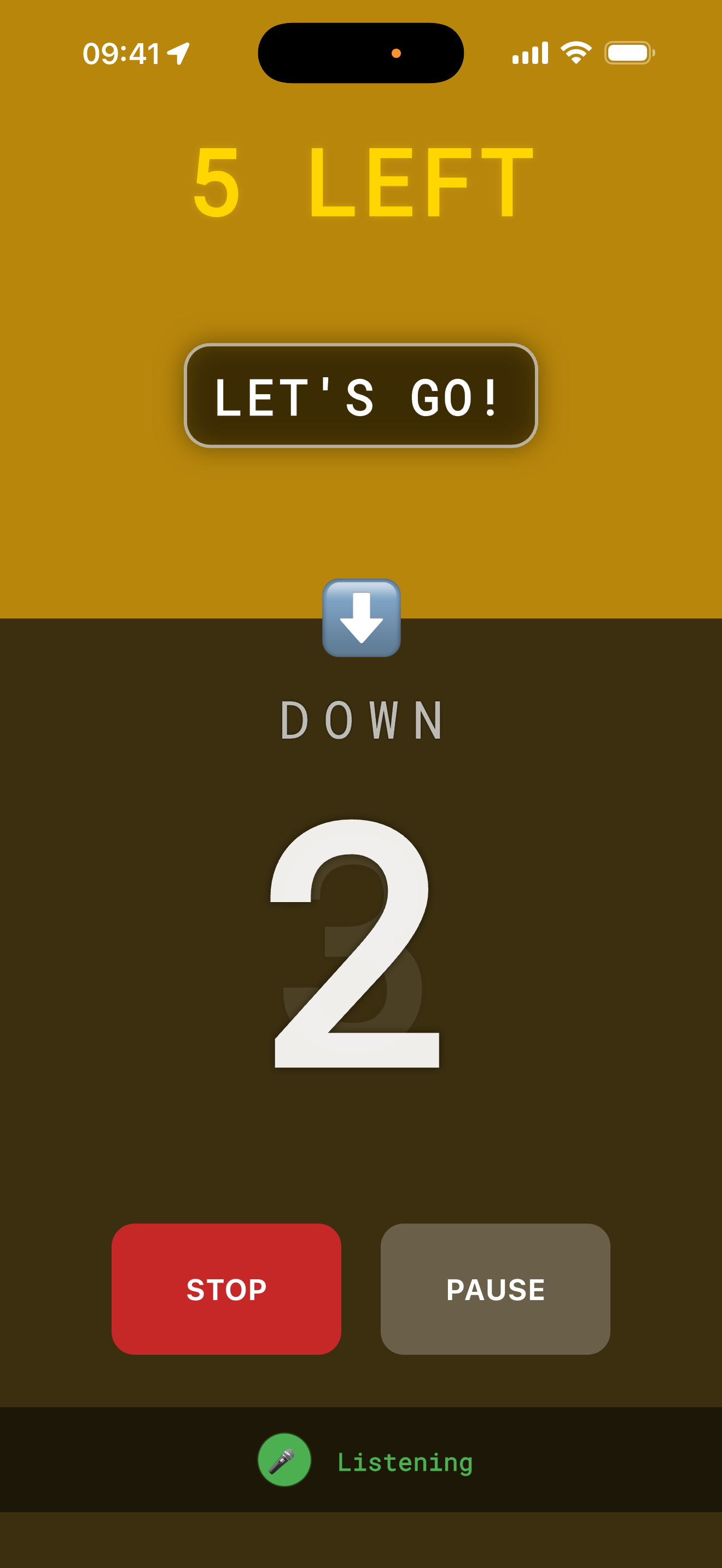
This is why every serious tempo prescription is paired with a counting mechanism - verbal counting, a metronome, or a tempo timer like Repko. Without one of those, the numbers are just suggestions.
Common mistakes when starting tempo work
The most common mistake is treating the eccentric as the only phase that matters. Lifters slow down the descent but bounce out of the bottom and rush the concentric. The 1-second pause at the bottom - the second digit - is often where the real work happens. It eliminates the stretch reflex and forces concentric strength to do the lifting.
The second mistake is choosing tempos that are too aggressive too soon. Going from a 2-0-1-0 cadence straight to a 5-0-1-0 means the load you can handle drops by 30-40%. That's a feature, not a bug - but only if you've adjusted the weight. If you try to keep your normal weight at a slower tempo, you'll fail mid-set with poor form.
The third mistake is using tempo on every lift, every set, every session. Tempo work is a stimulus. Like any stimulus, it stops working when overused. Use slow tempos in dedicated blocks (4-6 weeks), then move to faster cadences for power work, then return when you need the stimulus again.
What the research says
Tempo training has been studied since the 1990s. Here's what we know.
Optimal rep duration
The most cited paper on tempo and hypertrophy is Schoenfeld, Ogborn and Krieger's 2015 systematic review and meta-analysis (Sports Medicine, PubMed: 25601394). They found that repetition durations between 0.5 and 8 seconds produce similar muscle growth, while extremely slow reps (over 10 seconds per rep) appear to be inferior for hypertrophy.
This range matters because most useful tempo prescriptions fit inside it. A 3-1-1-0 rep takes 5 seconds. A 4-0-2-0 rep takes 6 seconds. A 2-0-1-0 rep takes 3 seconds. All within the productive range. The science doesn't say "slow always wins" - it says "deliberate execution within a range works".
Eccentric phase specifically
A 2024 study published in Frontiers in Physiology (doi: 10.3389/fphys.2024.1531926) looked at eccentric phase tempo specifically in squats. The researchers compared different eccentric durations while controlling other variables. They found that controlled eccentrics - in the 3 to 6 second range - produced both hypertrophy and strength adaptations, with measurable changes in muscle contractile properties.
A 2025 systematic review by Enes, Schoenfeld and colleagues (Journal of Strength and Conditioning Research, 39(12):1331-1339) extended this. They compared "slower" tempos (1.7-4.5 seconds per rep, averaging ~3.5s) to "faster" tempos. Both produced hypertrophy. The slower group did so with lower loads, which has practical implications for joint health and recovery.
Wilk et al. on tempo as variable
Wilk, Zajac and Tufano's 2021 review in Sports Medicine formalized tempo as a programmable variable alongside intensity and volume. They confirmed the 4-digit notation as the standard convention and outlined how tempo manipulation can be programmed across training cycles.
Bottom line: the science supports controlled tempo work in the 3-8 second per-rep range as legitimate stimulus for both strength and hypertrophy. It's not magic, but it's not snake oil either - it's a measurable training variable with real effects.
Tempo for different training goals
Strength: shorter total time, higher intent
For pure strength work, you want shorter time under tension. The classic prescription is 3-0-X-0 or 4-0-X-0 - controlled eccentric, no pause at the bottom (the stretch reflex helps you get out of the hole), and explosive concentric. The X in the third position is doing real work. It tells you to apply maximum intent to the bar - regardless of whether the bar moves fast or slow under heavy load.
This matters at heavier percentages. A heavy single at 90%+ won't move fast even with maximum intent - but the intent recruits more motor units, which is the actual driver of strength adaptation. Don't conflate tempo (the prescription) with bar speed (the result).
Hypertrophy: total TUT in the productive range
For muscle growth, the goal is total time under tension between 30 and 60 seconds per set. Working backward: a 3-1-1-0 tempo (5 seconds per rep) at 8 reps gives you 40 seconds. A 2-0-2-0 tempo (4 seconds per rep) at 10 reps gives you the same. Both work.
The variable that matters more than the exact tempo is consistency across sets. A set that drifts from 3-1-1-0 on rep 1 to 2-0-1-0 on rep 8 because you're rushing under fatigue - that's the kind of inconsistency that erases programmed differences.
Eccentric overload
For trained athletes, eccentric overload uses tempos that emphasize the lowering phase aggressively. Tempos like 5-0-1-0 or 6-0-1-0 with a load you can lower but not press concentrically. You need a partner or assistance device for the concentric. The eccentric is where you build tendon resilience and tolerance to load.
This is where tempo training crosses into rehab territory. Heavy slow eccentrics on Front Squats and Achilles raises are well-supported in tendinopathy literature. Read more about eccentric-focused training →
Calisthenics: where tempo becomes essential
Bodyweight training is the discipline where tempo work shifts from "useful" to "essential". You can't add 2.5 kg to a muscle-up the way you can to a bench press. Progress comes from changing the movement itself - and tempo is the most controllable variable.
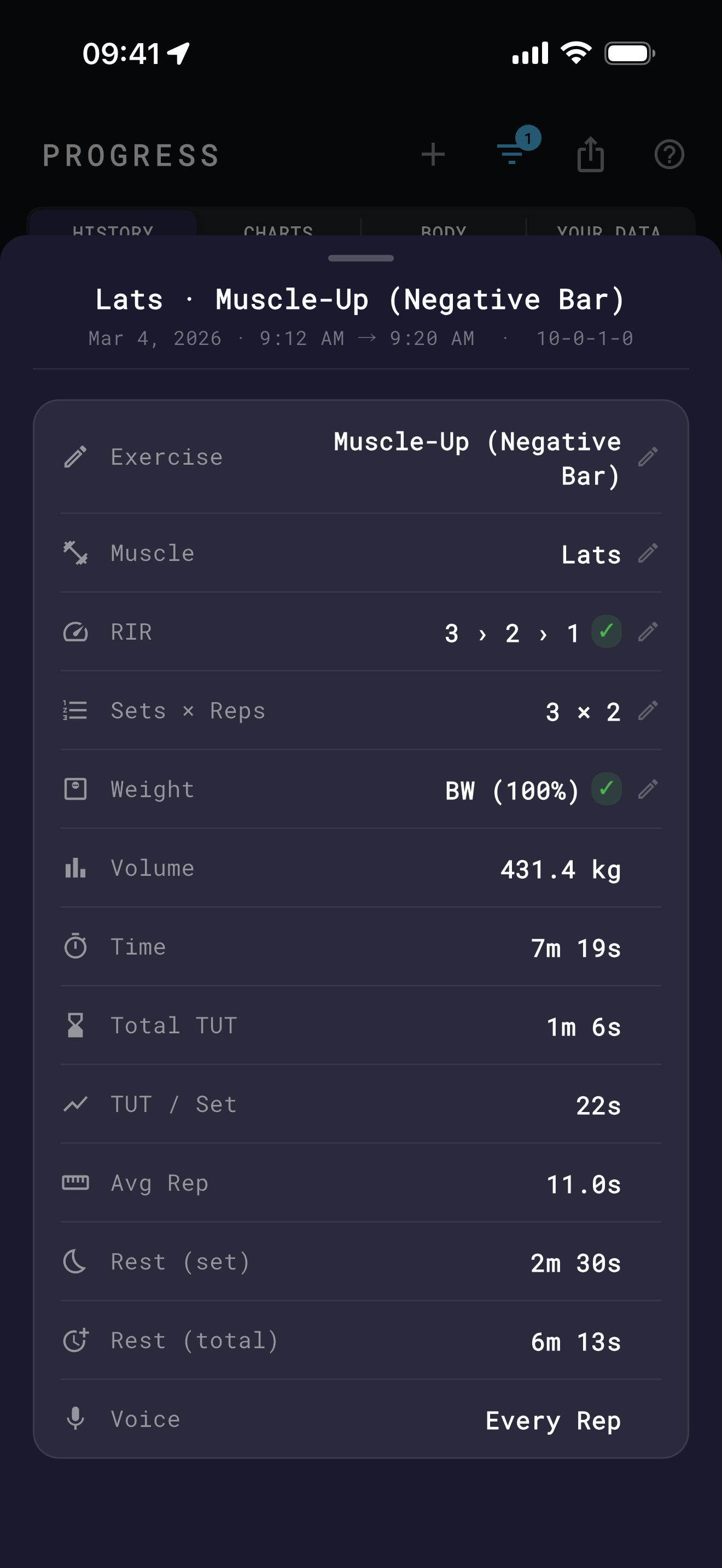
A muscle-up negative at 10-0-1-0 is a different exercise than a muscle-up negative at 3-0-1-0, even with the same body. The 10-second eccentric builds isometric strength at every position of the descent. It exposes weak points you'd never feel in a faster rep. This is why advanced calisthenics programs are built around tempo manipulation, not load progression.
A brief note on Charles Poliquin
The 4-digit tempo notation system used in this guide and across modern strength training was popularized by Charles Poliquin, a Canadian strength coach who passed away in 2018. Poliquin worked with Olympic athletes across multiple sports and published The Poliquin Principles in 1997, which introduced his methodology to mainstream strength coaching.
The notation itself wasn't entirely his invention. Australian strength coach Ian King had used a 3-digit system (eccentric - pause - concentric) earlier in the 1990s. Poliquin extended it to 4 digits by adding a pause at the top of the rep. That fourth number turned out to be more useful than it sounds - it controls the rest cycle between reps and changes the cumulative TUT across a set significantly.
Poliquin had his critics. Some of his more advanced claims about hormonal training and supplementation didn't survive scrutiny. But his core contribution - making tempo a programmable variable with a standard notation - has held up. The 2021 Wilk et al. review formally cited Poliquin's notation as the convention used in modern training literature.
This guide uses "Poliquin tempo" as shorthand for the 4-digit notation system. It's the practical language that strength athletes have used for 25+ years to communicate exactly how they want a rep performed. The science backs the method even where it might not back every claim its popularizer made.
How Repko compares to other tempo timer apps
Plenty of rep timers exist. What sets Repko apart is not a single feature but a combination that no other iOS app currently offers together: full four-phase per-rep tempo, voice control you drive by speaking, and speech that never leaves your phone.
| Capability | Repko | Typical dedicated tempo timers | Voice-controlled interval timers |
|---|---|---|---|
| Times all four phases of every rep (eccentric, pause, concentric, pause) | Yes | Sometimes (many collapse tempo to two or three phases) | No (they count intervals, not per-rep tempo) |
| Hands-free voice control (you start each set by saying "GO") | Yes | No (audio or haptic cues only, no voice input) | Yes |
| Speech processed 100% on-device, never sent to a server | Yes | Not applicable (no voice input) | Varies by app |
| Full core timer free, no paywall on the timer itself | Yes | Varies | Varies |
Other dedicated tempo timers count your reps well but leave you tapping or watching the screen. Voice-controlled timers keep your hands free but only run simple intervals, not a true four-phase tempo. Repko is the one app at the intersection: four-phase per-rep tempo you control by voice, processed entirely on your device.
Frequently asked questions
What does 3-0-1-0 tempo mean?
3-0-1-0 means 3 seconds eccentric (lowering), no pause at the bottom, 1 second concentric (lifting), no pause at the top. Total: 4 seconds per rep. It's a common hypertrophy-focused tempo for compound lifts like squats and presses.
Is tempo training only for hypertrophy?
No. Tempo training works for strength, hypertrophy, power, and rehab - different tempos serve different goals. Faster tempos with explosive concentric (X) suit strength and power work. Moderate eccentrics in the 3-4 second range suit hypertrophy. Very slow eccentrics serve eccentric overload and tendon work.
Should beginners use tempo prescriptions?
Yes, but simply. A beginner doesn't need 5-0-1-3 protocols. Start with controlled eccentrics - say, a 3-second descent on every rep - without worrying about the other digits. Once that becomes natural, add a 1-second pause at the bottom of compound lifts. That's already 90% of the benefit.
How does tempo affect how much weight I can lift?
Slower tempos reduce the load you can handle. A 5-0-1-0 squat will be 30-40% lighter than your 1-0-1-0 max. This is expected and correct. The tempo is the stimulus; the load is calibrated to the tempo, not the other way around.
What's the difference between tempo and time under tension (TUT)?
Tempo is the prescription (the 4 numbers). Time under tension is the result (total seconds the muscle is loaded during a set). TUT = (sum of tempo digits) × reps. A 3-1-1-0 tempo at 8 reps gives 40 seconds of TUT. Different tempos can produce identical TUT values.
What does X mean in tempo notation?
X means "as fast as possible" or "explosive" - it replaces a numeric duration with maximum intent. Most often you'll see X in the 3rd position (concentric) for power work, or the 1st position (eccentric) when you want to get into a hold position quickly. X is intent, not necessarily speed - under heavy load, the bar might move slowly even with X.
Why does Repko use 4-phase tempo notation?
Because it's the most precise standard available. Most timer apps simplify to 2 or 3 phases (just eccentric/concentric, or eccentric/pause/concentric), which loses information. The fourth digit - pause at the top - controls cumulative TUT and inter-rep rest. Repko was built by a lifter who needed the full notation for serious training, not a marketing-friendly version.
Is there a tempo timer app you can control by voice?
Yes. You start each set by saying "GO", and the speech is processed entirely on your device, never sent to a server. It is the only tempo timer I have found on iOS that does this. Other dedicated tempo timers give audio or haptic cues but take no voice input, and the generic voice-controlled timers run simple intervals rather than a four-phase per-rep tempo. If you find one that does both, tell me and I will correct this page.
What makes Repko different from other tempo timer apps?
Repko is the only iOS app I have found that combines all three of full four-phase per-rep Poliquin timing, hands-free voice control (you say "GO" to start each set), and speech processing that stays entirely on the device. Other tempo timers offer some of these. If one offers all three, I want to know about it. See the comparison table above.
Where can I learn more?
The most cited sources for deeper reading: the Schoenfeld 2015 meta-analysis on repetition duration (Sports Medicine, PubMed 25601394) and the Wilk, Zajac and Tufano 2021 review on tempo as a programming variable (Sports Medicine). The 2025 Enes/Schoenfeld systematic review in the Journal of Strength and Conditioning Research is the newest synthesis. For specific applications: eccentric training and heavy slow resistance. For the language of prescriptions: tempo notation explained. For specific lifts: front squat tempo prescriptions, deadlift and Romanian deadlift tempo prescriptions, lat pulldown and pull-up tempo prescriptions, bar muscle-up and negative tempo prescriptions, and side plank and McGill Big 3 tempo prescriptions.
Use tempo deliberately
Tempo training isn't a magic bullet. It's a way to make your training stimulus more precise - and more honest. The numbers force you to do what you're saying you'll do.
If you've never used tempo prescriptions, start with one block of work where every set has a 3-second eccentric, counted out loud. Run that for 4 weeks. You'll feel the difference in muscle quality, joint resilience, and your sense of what each rep is actually doing.
If you're already using tempo work and want a tool that handles the cognitive load - pacing, voice cues, automatic TUT calculation - that's what I built Repko for. It's free to try on the App Store, with no account needed and no PRO gate on the core timer.
Repko is live on the App Store. Read more about the app or follow development on Featurebase.